This lesson first appeared in Chicken Soup For The Sports Fan's Soul.
The year was 1964. The place was Chicago. A man I worked with had acquired a couple of special, all-leather, NFL-regulation footballs, inscribed -- 1963 Chicago Bears, and was selling them at a good price.
My first son was on the way. (This was in pre-ultrasound days, but I figured we had at least a 50/50 chance it would be a son. It was a chance I was willing to take.) I bought the football. I had my son's "coming home from the hospital" gift -- an all-leather, NFL-regulation football, inscribed -- 1963 Chicago Bears. That was something special.
Several years later, young Tom (we were not too creative in the name department) was rummaging around in the garage as only a five year old can rummage when he came across the special, all-leather, NFL-regulation football, inscribed -- 1963 Chicago Bears. He asked if he could play with it.
With as much logic as I felt he could understand, I explained to him that he was still a bit too young to play carefully such a special football. We had the same conversation several more times in the next few months, and soon the requests faded away.
The next fall, after watching a football game on television, Tom asked, "Dad, remember that football you have in the garage? Can I use it to play with the guys now?"
Eyes rolling up in my head, I replied, "Tom, you don't understand; you just don't go out and casually throw around an all-leather, NFL-regulation football, inscribed -- 1963 Chicago Bears. I told you before; it's special."
Eventually Tom stopped asking altogether, but he did remember. A few years later he told his younger brother, Dave, about the all-leather, NFL-regulation football, inscribed -- 1963 Chicago Bears that was special and kept somewhere in the garage. Dave came to me one day asking if he could take that special football and throw it around. It seemed like I'd been through this before, but I patiently explained, once again, that you don't just go out for no reason and throw around an all-leather, NFL-regulation football, inscribed -- 1963 Chicago Bears.
Soon Dave, too, stopped asking.
A couple of months ago I was in the garage looking for some WD-40 (which, with the aid of a rubber hammer, I use to fix about everything I choose to fix), when I noticed a large box that had "coveralls" written across it. I couldn't remember bringing along any coveralls when we moved from Chicago to Albuquerque, so I opened the box. There, long forgotten, was the all-leather, NFL-regulation football, inscribed -- 1963 Chicago Bears.
It wasn't special anymore. It wasn't special at all.
I stood alone in the garage. The boys had long since moved away from home, and suddenly I realized the football had never been so special after all. Children playing with it when it was their time to play would have made it special. I had blown those precious, present moments that can never be reclaimed, and I had saved a hunk of leather filled with stale air. For what?
I took the football across the street and gave it to a family with young children. A couple of hours later I looked out the window. They were throwing, catching, kicking and letting skid across the cement my all-leather, NFL-regulation football, inscribed — 1963 Chicago Bears. Now it was special!
You may not have a football stashed away in a coverall box, but do you have dishes that are too good to use, furniture that's too expensive to sit on, clothes and aged bottles of wine for that special occasion that never comes? Are you "doing more with less," "doing better faster," and "sticking twelve hours of work in a ten hour bag," to get more "things," while at the same time not using, or even appreciating, the "things" you do have? Are you letting the one-of-a-kind, never-to-be-repeated moments — the footballs in life — get away?
Lesson: If you save something long enough, you lose it.
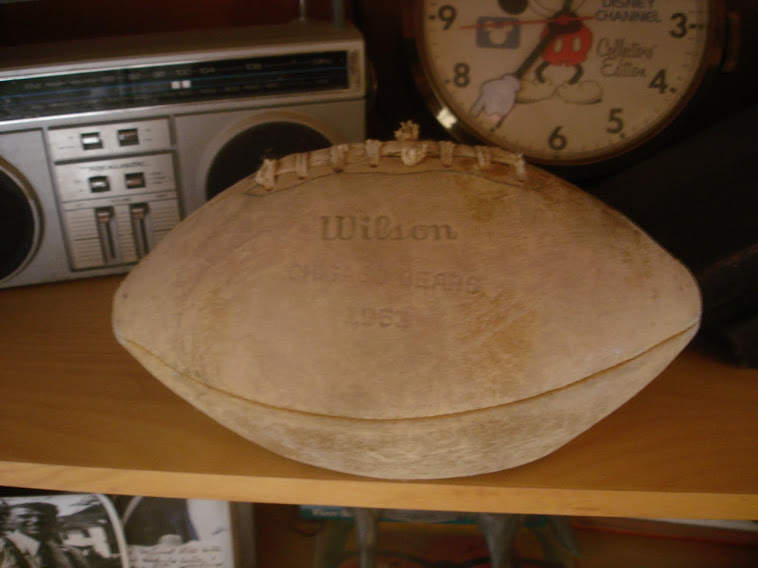
The all-leather, NFL-regulation football, inscribed -- 1963 Chicago Bears
Sunday, February 10, 2013


Monday, February 4, 2013
THE ANSWER MAN
Question #1
What would you do with the $10,000,000 grand prize from the Reader's Digest sweepstakes?
Question #2
What would you do if you lost or quit your job and no money was coming in?
Question #3
Which of the above questions do you find easier to answer?
Question #4
Which of the above situations in questions 1 or 2 do you feel has the greatest chance of occurring to you in your lifetime?
Question #5
Do you see any fertile opportunity for thought?
Lesson: Plan for the possibilities; it calms your nerves.
Saturday, January 26, 2013
CALL ME MR. LUCKY
They really had me worried for awhile.
Sure I lost a grade level, and my wages are frozen until hell is. I have more work to do than I even knew existed in my department, and I get the challenge of doing it with a reduced staff.
But, I'm one of the lucky ones. I'm a survivor.
Yes I know, there will be more cut-backs even though no one will confirm what we all know. There is more politics being played around here than in the smoky, back rooms of Congress.
But, I'm one of the lucky ones. I'm a survivor.
The family atmosphere is gone, so are most of my friends. The company focus changed. They seem much more interested in their bottom line than in my fulfillment and growth.
But, I'm the lucky one, aren't I? I'm a survivor!
Making the cut, being a survivor, that's a good thing, right? Consider the other side of the survivor coin. What happens when a person does make the cut, remains employed or in a relationship he or she no longer has a passion for, is excited about or committed to and does not feel able to leave that job or relationship? Are these survivors really the lucky ones?
Lesson: Getting what you think you want may cause you to rethink what you think you want.
Sunday, January 13, 2013
A THOUGHT
Whatever you did yesterday they can never take away from you. What did you do yesterday?
Lesson: Do something.
Sunday, December 30, 2012
WHO HAS WHO?
"Bullfeathers"
That's the paraphrased response from a women in the audience when the subject of releasing our perverted death grip on company benefits was discussed.
"I've worked too hard to let go of my benefits," she continued with great passion. She had a point, but I worry for many folks. People I knew in business who use to talk about the projects they were working on or the brain-dead boss they were working for now start off their conversations with: "I only have 4 years, 3 months, 2 weeks and 5 days until retirement."
It's important to remember: everything you do has a price. What price is being paid for your benefits, and who is paying that price? If you're aware of the price and are willing to pay it, that's fine. If you put up with a job that drains your passion and diminishes your spirit so that you can get your teeth cleaned free twice a year, so be it.
When I left the company I was with for 17 years, I marched out proudly (albeit naively) with no medical, no dental and a vested pension. (When I took the pension at 65 it just about covered the cost of Metamucil.) When I started by own company I had a pension plan, and health insurance. How did I get it? I did it the old fashioned way, I paid through the nose for it. But, I did a job I loved and lived in the part of the country I love.
Lesson: Company benefits are something you have; they shouldn't have you.
Tuesday, December 11, 2012
QUINTESSENTIAL WORK
Be prepared to argue with me.
I don't believe anybody's work is more important than anybody else's work.
"What? Are you saying the work of Mother Teresa was no more important than the work of Mrs. Murphy who makes cat toys?"
I'm sure the casual observer sees a difference, but it doesn't have to be different to the two women.
If you feel a zeal, devotion, and intensity for what you do; what you do is not harmful to the community; and you do it to the best of your ability, there is no difference in the importance of the work itself.
All work, paid or unpaid, is inherently important. Work is important for the benefit it provides the community. (Without benefit the work won't last.) Also work is important for the sense of accomplishment it provides the worker. (Without accomplishment the worker won't last.)
Sure, the outcome of some work, by its very nature affects more people than others, but does that make the essence of that work more important?
Is the actual "work" of a pilot more important when he's flying alone or when he has a few hundred people aboard? The "work" of a doctor when she is treating one ghetto child or researching a cure for cancer?
Doctoring and piloting are important by themselves regardless of how many people they affect.
So is making cat toys.
Yesterday when I laughed at my cat chasing around a catnip filled replica of a rodent, the experience made more of a positive difference in my life that day, that moment, than Mother Teresa's work has done.
I just hope Mrs. Murphy knows that.
Lesson: All work is important; experience it that way.
Thursday, November 29, 2012
CAN'T GET OUT WHAT YOU DON'T PUT IN
What is:
Essential for effective communications?
A cornerstone of healthy relationships?
Dispensed slowly?
Yanked quickly?
Desired in our daughters' boyfriends?
Vital to all organizations?
Missing in most organizations?
An ingredient in high performance teams?
Abundant in our God?
Lacking in our politicians?
The answer: trust.
Trust is a belief and confidence in something or someone. You either have it or you don't.
Whether trust is in your personal bag of virtues or not doesn't stop you from being asked to display it. How often and in how many ways in your work and personal lives are people asking you to trust them? Occasionally it's easy because you do trust them, and you will gladly and confidently do what they ask. Sometime it's easy because you don't trust them and would never do what they ask even under the threat of having to spend time alone with a mime.
The challenge comes when you're asked to do something you feel you should do that requires a level of trust you don't have. Friends may ask you to play the "Trust Me" game without historically having produced any legitimate reason for you to do so.
In life you can find yourself backed in a person or professional corner frantically searching for trust from people whom you have never given a reason to trust you. If you didn't have people's trust before you needed it, you'll never have their trust when you do need it.
Lesson: Deposit often in the trust bank. You never can tell when you'll need a withdrawal.
Sunday, November 18, 2012
CATS, BIRDS, AND WORMS
One beautiful, Southwestern morning, I was in the shed filling up a bucket of birdseed to feed and nourish all the winged species we have here in the mountains.
As I took the bucket-o-seeds around to the back bird feeders, I saw something which gave me pause for thought -- our cat, Sydney, in a brazen example of nature's inescapable food chain, was eating a bird.
I was struck by the irony. I'm feeding the birds; my cat's eating the birds.
Sticking with warm-blooded, egg-laying, feathered vertebrates, it's often said, "The early bird gets the worm." Then doesn't it also follow that the early worm gets eaten?
You get the promotion, somebody else doesn't, Somebody else wins the turkey raffle, you don't. The good die young, the bad live on.
In life you don't always win and often you're darn lucky to come out even. Life is going to do to you what life does to you. Why is there a tendency in us humans to feel unfairly treated when we don't get what we want? In nature what's fair for the cat is sure not fair for the bird. What's fair for the bird is a real bummer for the worm.
Lesson: Fairness is a non-issue. Some days you're the cat, some days you're the bird.
Saturday, November 10, 2012
READY OR NOT HERE WE COME
Do you ever wonder if these new-fangled concepts that you are exposed to on a daily basis are really any better than the old ways?
To flip a classic rebuke, "Don't just do something, stand there." Are the decision makers at work and at home merely "doing something?" Should they "stand there" for awhile to insure that the new is really better than the old?
Consider the thrust to change management and parental styles. Is the new participative method really better than the old authoritarian? If God didn't see a need for authority, wouldn't he have sent Moses down from the mountain with the ten suggestions?
I'm certainly not against change, but as fellow travelers in these dynamic times, we must be real clear as to the changes we initiate. Will the changes you generate create real growth, or is change being implemented simply because you're not sure what else to do?
The tried and true may not always be the most glamorous way to go, but before committing to a new idea, think it through and back again. If you're not ready on all fronts to change, you may be better off to refrain from "doing something" and just "stand there" until you are ready.
Lesson: Don't blindly jump on the change bandwagon until you're sure you want to go somewhere.
Saturday, November 3, 2012
BELIEVE ME
One day I was driving down a highway in rural New Mexico, doing a tad over the speed limit, when I saw ahead a car doing exactly the speed limit. Physics dictates a showdown.
My first thought was, "This person must be new to New Mexico." As I came closer, my "passing genes" kicked in. Positioning myself for a shot at the lead, I perceived a slight problem -- I was about to pass a police car.
My decision to pass or not to pass a police car would seem a given, but not in this case. The car in front of me was not your everyday state police, but a Navajo reservation police car. My belief told me that the reservation police do not give tickets on a federal highway -- at least that's what I thought I believed until it came time to test my belief.
Test results: I followed that car until I reached my destination. So much for the intensity of that belief!
Your new girl friend seems like an honest, open, trustworthy, reliable kind of person and you believe possibly this could be the one. The night of your fifth date she calls you on skype and tells you how much she values your opinion. She has just bought a new outfit to wear on your date tonight. You are waiting for her to get out of the clown outfit she is wearing and show you what she bought. Suddenly you realize this refugee from Barnum and Bailey is indeed wearing what she bought! "How do you think I look?" she asks. "Trust me, you can tell me anything."
Lesson: You never really know how much you believe in something until there is some risk involved in that belief.
Saturday, October 27, 2012
WASHROOM TECHNIQUES
"Boy, what a waste of time that was!"
Be honest, did you ever say that at the end of a meeting?
If not, you are indeed one of the fortunate few. If so, who did you blame for wasting your time? My guess is you blamed the person who ran the meeting. He or she is the most obvious "blamee." When all is said and done (and it usually is at a meeting), who has the responsibility to insure that your valuable time is not wasted? I'll give you a hint. You were in the shower with that person this morning.
You know intellectually how you use your time is your responsibility, but accepting that fact rationally is difficult and even more difficult is doing anything about it. So what chance do meeting leaders have to correct what's wasting your time if you don't tell them?
In The classic book, The Empowered Manager, Peter Block gives some remarkably practical advice to meeting leaders. He suggests that if you really want to know how well a meeting you are running is going, during the break you should slip into the washroom, go in a stall, put your feet up and listen to what everyone is saying!
Typical meeting scenario:
A leader asks, "Any questions, comments or concerns?" Attendees say, "no," then go on break and complain like hypochondriacs at an AMA convention. Back in the meeting after the break, leader asks for any questions or comments before going on and is greeted with total silence. And after the meeting, the "waste of time" litany commences.
Lesson: Only you can waste your time.
Thursday, October 18, 2012
Wednesday, October 10, 2012
WHO TOOK WHAT FROM WHOM?
Many years ago our son Dave was home with us for winter holiday break. He was attending the University of Iowa. We hadn't seen him for a while, and this promised to be a good time. It was, up until he received -- the telephone call.
The call came from one of his roommates. Their house had been robbed and all of Dave's expensive musical instruments and sound equipment was gone.
Dave worked very hard to be able to afford these treasured items. As might be expected, he was one discouraged temporarily ex-musician. Then, an all-to-human phenomenon occurred. Dave began to concentrate on all he had lost. And once that "lost train" leaves the station, it just picks up speed.
Dave lost more, he lost sleep, lost appetite, lost temper and lost time on his vacation by cutting it short to get back to the scene of the crime.
Our second born gave to the antisocial misfits more than they had taken. Sure the pukes took his equipment, but Dave chose to give the knuckle-draggers his sleep, appetite, temper and vacation. He quickly recognized this line of thinking was not very productive. It didn't get his equipment back, nor did it punish the materially disadvantaged cretins. The only one being punished was Dave, and he was doing it to himself!
What happened, happened. How to make silk out of this sow's ear was now the question. So Dave in his creative and customarily optimistic style reframed the situation. He was no longer "stolen from," his equipment was merely "borrowed by an unidentified person without his permission for an indefinite period of time."
Case closed, on with life.
Lesson: People may take your "things," but you are the only one that can let them steal your moments.
Sunday, September 30, 2012
BUFFY THE LIFE SLAYER
I was examining the "table readings" provided by a cutesy, theme restaurant. Among the color pictures of desserts the size of which do not exist in the real world and the variety of beers offered so you will not realize how short changed you're getting on dessert, was a rather curious card which read:
"I am EMPOWERED to make sure that you ESCAPE FROM THE EVERYDAY.
If you need anything just ask!"
This preprinted 3 X 5 card was signed by Buffy, the waitress.
Do you really need to "escape from the everyday?" Even if you think you do, do you really believe Buffy could do it for you? If she could, who empowered her to make your life more exciting?
"Everyday" is what makes up your life. Every big and important or little and inconsequential thing you do added together equals the sum total of your existence. Why would you want to "escape" from that which makes you up?
Buffy, stick to apologizing for the desserts.
Lesson: Without everything that has happened in your life, you'd be someone else.
Monday, September 24, 2012
PERSPECTIVE
Remember the last time you dug a ditch 100 feet long, one foot deep?
My ditch went from a shed to a fence at the lot line. Ten minutes of digging, followed by one minute of rest. Ten digging, one resting. After about 3 repetitions of the preceding, I looked toward the fence and it seemed, if anything, to be getting further away.
Do any of your life's goals, when concentrating on them, seem to be getting further away? We're told to focus on our goals, to visualize accomplishing all we want, and to imagine how we will feel when we have what we want. When we do concentrate, focus, visualize and imagine, we drop to our knees in frustration over how far we have yet to go.
After two more repetitions in my quest to dig to the distant fence, I put down the shovel. I expelled a big sigh and out of the corner of my sweat stung eye, I caught a glimpse of the shed, my starting point, which was now further away from me than the fence was.
Lesson : Don't be discouraged about how far you have to go; look at how far you have come.
My ditch went from a shed to a fence at the lot line. Ten minutes of digging, followed by one minute of rest. Ten digging, one resting. After about 3 repetitions of the preceding, I looked toward the fence and it seemed, if anything, to be getting further away.
Do any of your life's goals, when concentrating on them, seem to be getting further away? We're told to focus on our goals, to visualize accomplishing all we want, and to imagine how we will feel when we have what we want. When we do concentrate, focus, visualize and imagine, we drop to our knees in frustration over how far we have yet to go.
After two more repetitions in my quest to dig to the distant fence, I put down the shovel. I expelled a big sigh and out of the corner of my sweat stung eye, I caught a glimpse of the shed, my starting point, which was now further away from me than the fence was.
Lesson : Don't be discouraged about how far you have to go; look at how far you have come.
Sunday, September 16, 2012
GOAL FEVER
Do you get really frustrated when somebody tells you that the way to attain all of your personal and professional objectives is to set effective goals?
It aggravates me because I believe I set effective goals. My goals are written, definitive, committed to and environmentally acceptable. Yet I don't always get what I want. I should, shouldn't I? I follow all the rules.
Don't all politicians enter the race with the goal of winning? Don't you strive to accomplish your work goals? Don't you enter tennis or golf matches with the goal of winning?
During the opening ceremony of the '92 Summer Olympics, swimmer Ron Karnaugh's father died. Ron committed to swim in his father's memory. When it was Ron's time to race, he wore his father's hat in the pool area, looked up to the sky as if to ask his dad for some additional inspiration, dove into the pool and finished sixth.
I've discovered over the years, as I'm sure Ron did on that Olympic-sized day, that I can set all the goals I want but if there are five swimmers faster than I am, I lose.
To avoid frustration and aggravation, consider this statement: A true goal is a commitment to accomplish some worthwhile outcome that is WITHIN YOUR CONTROL.
This doesn't mean you should not envision and aspire to accomplish desired results out of your specific control. It's important for you to have a direction and focus. But it's also important for your own emotional health and well being to recognize the level of influence you really exert over certain goal attainment.
Maybe there is a need for two different levels of goals?
Level One Goals — goals you strongly influence by your own actions. For example: finishing college, learning a foreign language, running in a marathon.
Level Two Goals — goals you influence by your actions but the ultimate decision as to whether the goal will be accomplished rests with somebody or something else. For example, sales objectives, games, politics, winning a marathon, etc.
Attaining Level Two Goals is certainly desirable, but remember a completed level two goal will always be the successful attainment of a series of Level One goals, with a dash of luck thrown in. Life is enough of a challenge without whipping yourself over results that are not within your direct control.
Lesson: It's useless at best and frustrating at worst to set a goal whose outcome depends on something outside oneself.
Sunday, September 9, 2012
THE ANTI COACH
It was third down, two yards to go for a first down at our opponent's ten yard line. We (St. Patrick High School) were on a roll. I was playing fullback on that memorable Sunday afternoon. (The afternoon was memorable because we were on our way to a touchdown. This touchdown could win the game for us and winning was a unique occurrence for the St. Pat's Shamrocks back then.) The coach called all the shots and sent in the halfback with the play the coach felt could get us the touchdown and salvage some degree of respectability, not to mention his job. The halfback joined us in the huddle with the play. The coach, in all his wisdom, had called my number, I was going to carry the ball.
Just before we broke the huddle, the halfback leaned over to me and provided the coaches words of encouragement, which you are unlikely to find on a motivational poster, Coach said. "whatever you do, don't fumble." To this day the ball has not been located, and I picked up the name "Cinderella" because I missed the ball.
Golfers, do you ever say to yourself, "O.K. duffer, whatever you do, do not put this ball in the water." Then you tee up an old scuffed, scratched, oblong, "water ball" just to give validity to your pessimism.
"Whatever you do don't say anything about the big bump on Aunt Martha's nose." A sure way to get into a nose bump discussion with Aunt Martha.
Our minds cannot focus on the opposite of an idea. You can't focus on not doing something. You do a major disservice when you tell yourself or others what NOT to do. Focus on what you want to see happen, not on what you do not want to see happen
This positive focus is not only important when dealing with ourselves, look what happens when we focus on what we don't want others to do. Since I'm already on the football coaches manure list I'll just dig myself in a little deeper.
While playing football in college, the coaches took movies of each game. (This was B.V.-- Before Video.) They took movies to "help us become better players." The way our coaches conducted those session they worked in much the same way as the electric chair helps convicted murders become better citizens.
I remember one game in particular. The camera focused on an opposing player running around end, and as luck would have it, yours truly was the only one between the runner and a sizable gain. I never had the quickest reflexes even so, I felt pretty good about myself and my abilities--until exposed to a little help from my coaches.
The camera was able to isolate just the runner and me. He faked; I bought it, put a great tackle on where he used to be and, in compliance with the law of gravity (which had just been enacted), settled in a cloud of dust. It was all natural turf in those days. The camera caught every agonizing moment of that play.
(Anybody who has ever played in a sport where movies or video tapes were taken by the coaching staff, knows what is coming.) At the next practice session, when the coach came to the part of the movie where the tackle was missed, he showed the play, rewound it, showed it again, rewound it, showed it again, and rewound it for what seemed like half of my life. All the time he was telling me, and anyone else who would listen, while also reinforcing my "failure" visually, what a lousy tackler I was.
What had my coach accomplished? Did I see myself as a "tackler" or a "non-tackler" when I left the meeting? I was just coached for a whole hour on how not to tackle!
Sports are an easy way to demonstrate the negative effect of focusing on what you don't want to happen, but its not the only way.
I'm sure many of you remember Karl Wallenda, the founder and father of the famous high wire act, the Flying Wallendas.
I'm also sure it would surprise Karl to find his tale being told around the campfire in many personal-improvement training programs. His story is called, curiously enough, the Wallenda Factor.
The Wallenda Factor, as reported, goes something like this. Prior to his death in 1978, according to his wife, the lovely and talented Mrs. Wallenda Factor, all Karl thought about was falling. He obsessed over the wire, the winds and the whatevers. While that line of thinking does not sound unusual or unwarranted, it could be fatal. Because as we have said there's no future in focusing on what we don't want to have happen. For Karl that turned out to be literally true.
Focusing on falling was probably not the best thing for Karl to think about before boosting himself 75 feet in the air over downtown San Juan, Puerto Rico.
The obvious, yet often ignored, point of the WF is if you get what you think about most, why would you think about what you don't want?
Do you define major portions of your life by what you're against?
Lesson: Focusing your energy on what you don't want to happen not only doesn't work, but doesn't leave much energy for what you do want to happen.
Sunday, September 2, 2012
BUCK,BUCK,BUCKET
I believe you get up each morning and pick up your personalized "stress bucket." As you go through the day your bucket gets full. When your bucket is full, what do you do? You dump your bucket.
Mature people have a healthy, productive way of dumping their buckets. They exercise, laugh, meditate, garden or breathe deeply. Immature people simply dump their buckets into someone else's bucket.
Immature people are those people who call a meeting, burst through the door like crazy persons yelling, screaming, and exit feeling so much better. But the immatures leave a room full of people so uptight those attending the meeting won't be able to exhale for a week.
You see the immatures at work, on the highways in the grocery stores and in the airports taking it out on whomever. They dump, feel temporarily better, move on and leave a trail of stressed people strewn in their wake.
Not only do the immatures come off like spoiled children, they are also ineffective. The reason dumping one's buckets into another's doesn't work in the long run was best explained by that distinguished philosopher Forrest Gump. In the movie of the same name, Forrest's friend was throwing rocks in anger at her old house. Forrest looked at her and Gumped: "Sometimes there's not enough rocks."
Lesson: Your stress is like a boomerang -- it's useless to toss at anyone else.
Thursday, August 23, 2012
MONOPOLY IT AIN'T
They say life is a game. Well, it's one heck of a game if you ask me. It's a game two other people got you into without your approval. You have to find out the most important rules for your self while simultaneously playing the game, and, most interestingly, you can't win. No thanks, I'll pass on that game. Oops! I can't do that either. If I'm alive, I'm playing.
The life game does have a winner, it's just not you. Death is the ultimate winner. Death is like a well-camouflaged, sharp-shooting, game piece hidden behind the heavy trees on the ridge overlooking your life being played out in the valley below. Death's job is to pick off everything of importance around you. Maybe on a slow day Death will just play with your world like a cat plays with a mouse. He will wound or take out those special to you just for something to do. Then when death gets really bored he'll put a slug right between your eyes, and there is not one darn thing you can do about it. Death always wins.
I know this sounds cynical, but reality often does sound cynical. When you really "get' that life and the lives of those around you are finite, only then can you begin to truly live life the way it is, not the way you would like life to be.
If you view immortality as winning life's game, you're a loser right out of the blocks. Who would want to live forever? As Woody Allen said, "Some people want immortality and they can't think of what to do on a Saturday night." If you look at life as a trip, as something you do between birth and death, you win the game by simply enjoying and maximizing each day. Enjoying what you have when you have it is the only way you can thumb your nose at the sniper on the hill.
Lesson: Life's game is not about winning or losing; it has to be about how you play the game because there is nothing else.
The life game does have a winner, it's just not you. Death is the ultimate winner. Death is like a well-camouflaged, sharp-shooting, game piece hidden behind the heavy trees on the ridge overlooking your life being played out in the valley below. Death's job is to pick off everything of importance around you. Maybe on a slow day Death will just play with your world like a cat plays with a mouse. He will wound or take out those special to you just for something to do. Then when death gets really bored he'll put a slug right between your eyes, and there is not one darn thing you can do about it. Death always wins.
I know this sounds cynical, but reality often does sound cynical. When you really "get' that life and the lives of those around you are finite, only then can you begin to truly live life the way it is, not the way you would like life to be.
If you view immortality as winning life's game, you're a loser right out of the blocks. Who would want to live forever? As Woody Allen said, "Some people want immortality and they can't think of what to do on a Saturday night." If you look at life as a trip, as something you do between birth and death, you win the game by simply enjoying and maximizing each day. Enjoying what you have when you have it is the only way you can thumb your nose at the sniper on the hill.
Lesson: Life's game is not about winning or losing; it has to be about how you play the game because there is nothing else.
Thursday, August 16, 2012
LOCATION, LOCATION, LOCATION
As we landed in Los Angles the sun was shining and the airline had not lost my luggage, overall a good flight. Now all I had to do was get the rental car and I'd be on my way.
I had given speeches in the LA area before and felt reasonably comfortable finding my way around. This was pre-GPS so I just had a map of the area with my destination clearly marked by my client with bright yellow magic marker. There should be no problem finding the place. Getting lost when I have a time commitment tends to release my stress juices. Not needing that particular adrenaline rush, I thought I'd verify my driving plan with the desk agent at the rental car counter.
"Can you exit the 105 at Western?" I asked in my best guy-asking- directions tone. "I dounno," came the reply from the most recent Dale Carneige drop out. "Ask the guy down where you pick up your car," he mumbled. I guess if you "dounno", you "dounno", so I slupped my bags to the rental car pick-up.
"Can you exit the 105 at Western?" I tried again in my best annoyed-guy-asking-direction tone. This guy was much more helpful. I think so," he said. Well I thought so too, and within my world two "thinks" equal a "know," so I went for it.
Wrong.
After driving longer on the 105 than I thought I should (I started seeing signs for Pittsburgh), I pulled off the highway and parked on an unfamiliar side street to get my bearings.
I figured with my trusty, handy-dandy map my "bearing getting" should be a snap. I pulled out the map with the designation brightly highlighted and sat there staring. It was then I learned another of life's bountiful lessons.
Lesson: Knowing where you're going is useless if you don't know where you are.
Subscribe to:
Posts (Atom)