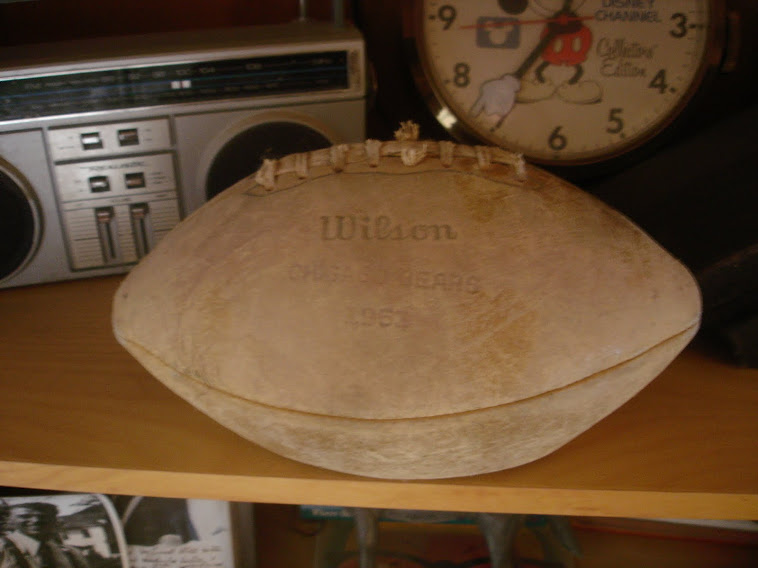
The all-leather, NFL-regulation football, inscribed -- 1963 Chicago Bears
Thursday, September 1, 2011
WHO ME?
When I was asked to write an article for a book on success stories, my first thought was "What can I contribute?" I haven't been trapped in a coal mine and saved 25 of my coworkers. I haven't been on a Super Bowl winning team, adopted ten handicapped children, triumphed over massive head injury or built a multi-million dollar international company from the ground up.
Not only haven't I done any of those things, I don't personally know anybody who would qualify as the classic "success" story. That thought discouraged me until I realized something might be wrong with the classic meaning of success.
A friend had told me he was having more fun ever since he rethought and redefined fun. I think it was time for me to rethink and redefine success.
I decided success is not about winning at sports, finance, business, social status, or overcoming adversity. Success is about each of us doing our best at what we think is important.
Since we all don't believe the same things are important, who is to say each life is or is not a success story? Only we know how far we've come and how far we want to go. We must not allow anyone else to determine our success.
My mother committed 24 hours a day to raising two, clean, God- fearing, vegetable-eating boys. My father was a policeman for 40 years. He kept his nose clean even though he had plenty opportunity to line his pockets with ill-gotten gains. Instead he worked three jobs to insure his children a better life than he had. Successes? You bet.
Millions of people everyday who go about their lives contributing to their community by doing an honest day's work, caring for their families, worshiping what's in their heart to worship, and being gentle to others and the environment are successes. The family across the street that takes in foster children, the man from the office who works with the elderly on the weekends, the friend who suffers illnesses courageously, people who leave the world just a little better than when they came - those should be our heroes. These people are our genuine success stories, and they are everywhere we look.
We each have within us an extraordinary success story. So what if nobody else wants to hear it or Reader's Digest won't print it. The stories are ours, and nobody can take away from us the successes we are when we're doing our best at what we feel is important. You may have wanted to be like the late Paul Newman and ended up more like Alfred E. but you're a a success if you are the best Alfred E. you can be.
Lesson: You're most successful when doing your best at what you feel is important.


Monday, August 22, 2011
THAT OLD GREEN MAGIC
A man wakes up from a 20-year coma and calls his stockbroker. He asks the value of his $75 thousand worth of stock. The broker tells him $4 million. The man almost goes back into the coma. The computerized operator then comes on the line and says, "That will be $5 million for an additional three minutes."
What does money really mean?
When he was quite young, Grandma gave my older son, Tom, $2.00 to spend at the flea market. The first item he saw that intrigued him was a brand-spanking-newly minted dollar bill sold at the booth of a coin dealer. Tom liked the looks of the crisp, encased dollar bill. Though too young to do any serious collecting, he bought it for his $2.00.
As the day wore on and his fascination with the dollar bill wore off, he passed a booth selling toys. He saw a 60-cent squirt gun that looked better to him at that moment than the crisp, newly minted, encased dollar bill. He used the $2.00, $1.00 bill to buy the 60-cent squirt gun.
As we were driving home, my wife Jean and I mulled over the morning events and realized that Tom was not exhibiting the characteristics of a Warren Buffet (or maybe even a Jimmy Buffet for that matter). We, his sensible parents, had walked around a flea market for over two hours. We had seen many interesting items we would have liked to have, but being practical and business-like, we were going to save our money until we got well into our 90s -- then we could get whatever we wanted.
Now Tom, having parlayed his $2.00 to a 60-cent squirt gun with a few pennies left, did not demonstrate good business - not good business in the financial sense. But in the big-picture sense, Tom traded in money that has no value in itself and all day long had in his possession what to him did have value. His parents, on the other, hand drove home practical, business-like and empty-handed.
What good is our money, whatever the amount, if we don't have our squirt gun when we want it?
Lesson: A dollar saved is smart. A dollar spent is fun.
Subscribe to:
Posts (Atom)