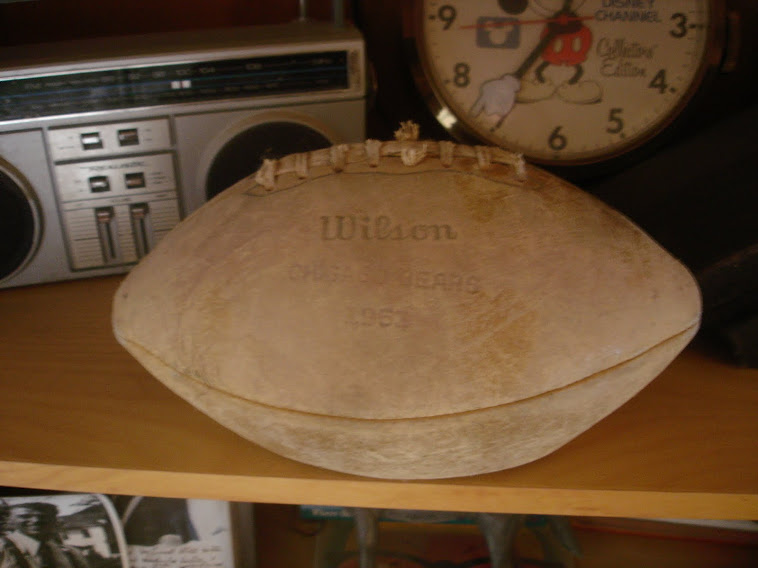
The all-leather, NFL-regulation football, inscribed -- 1963 Chicago Bears
Thursday, July 26, 2012
FROM THE INSIDE OUT
The medical profession is known for it but I believe every profession should accept it as their guiding principle. Truthfully, I believe it should be the guiding principle of life in general! "It" is: DO NO HARM.
Think about how much better everyone's life would be if each individual (who makes up everyone) did no harm? How much better would your time here on earth be if all people dedicated their lives to not harming themselves, their family, their community and their environment?
Shouldn't you dedicate your life to doing good? "Good" sounds like something you should be doing, but I believe first you do no harm, and if you have time left over, then you can do some good.
Imagine a twenty-four hour period where you just take care of you; you eat all the appropriate food groups, sleep your eight hours, and exercise your mind and body. You treat each member of your family with honor, love and respect. You are a contributing member to your community, and you are gentle with the environment. Sounds like a full day eh? Once you've done all of that, you're now free to spend the rest of your day doing good, if there is any good left to be done.
Lesson: If we each take care of our self there will be nobody left to take care of.


Saturday, July 21, 2012
SO MUCH TO DO AND SO LITTLE TIME
I found a list of "to do" items in a book I took from my brother Bill's office.
This would not have been an event worth remembering, much less included as a lesson, if it hadn't been for the fact that I got the book when we were cleaning out Bill's office after his death.
A "to do" list for a person who has died set me to thinking.
These were items in Bill's hectic, get on and off an airplane, take a taxi, check into a hotel, make a difference in the lives of people, check out, get on an airplane and start all over again, world. These were activities he believed he needed to accomplish to make his life and the lives of those he touched, meaningful.
Bill was, when you sort through all of the adjectives, a teacher. While he was my younger brother I followed him into the world of improving organizational performance by concentrating on the fulfillment and growth of each individual. Granted I may not be very objective for many reasons, but I believe Bill's work was important. Bill gave it everything he had and was darn good at it.
He took his work and his life seriously (a family trait), so those "to do" items were to Bill a real commitment. But to see them in the context of life and death definitely put "9 a.m. meet with Dean" into perspective.
I would like to restate my philosophy of life -- You're born, you die, and in between you do something. As simple as this philosophy is to understand, it takes most of us our entire time here on earth to figure out what that "something" is.
When Bill was diagnosed with cancer of the esophagus (Warning: not taking consistent heartburn seriously may be harmful to continued life), we spent time together just talking. Talking about things other than business was something we hadn't done in years. (Warning: not taking consistent time out with someone you love may be harmful to living a life worth continuing.)
I had recently read an article in Reader's Digest on 50 things the author wanted to do before she died. I told Bill that I couldn't think of more than two or three things that I wanted to do, Bill felt the same way. This meant that we had either done everything (which we knew was not the case), or our "possibility gene" had atrophied.
This exercise reminded me of one of the most depressingly accurate quotes I had ever read. Jean De La Bruyere said, "There are but three great events in a person's life: birth, life and death. Of birth he is insensible, he suffers when he dies, and he forgets to live, While Jeano was probably not the life of the party, he was sure reading my mail.
Being unaware during birth is true. Suffering at death will also to some degree be true, but it's the forgetting to live piece, true for far too many, that's the most disturbing.
It's most disturbing because while you don't control your birth or the amount of suffering you experience at death, you do control whether you remember to live.
Over time, when you take life too seriously and your "to do" list gets too long, you close out all other possibilities. You're born, you work on your "to do" list, then you die. If you don't fancy that as your epitaph, what are you doing to change it?
Because of some errant cells my parents lost a devoted son, Joan lost a loving husband, I lost my brother/friend and you lost -- Bill. In his life he taught thousands of people how to work. In his death, he taught me to live.
Lesson: If you don't live a life, you don't have a life.
Subscribe to:
Posts (Atom)